My photo
Santa Barbara, CA, United States
I enjoy creating original wine-pairing recipes that are healthful and delicious. I work for Touring & Tasting a Santa Barbara based wine club and national magazine as Food Editor. However, I am not paid for this blog and the opinions expressed here are strictly my own. I received my Personal Chef Skills Competency Award from the SBCC's School Of Culinary Arts. In 2012, I started Inside Wine - Santa Barbara with pal Lila Brown which features wine tastings with winery owners and winemakers. I also serve on the Board of the Santa Barbara Culinary Arts group, which had Julia Child as one of the founding members and funds scholarships for SBCC culinary students in her name.

Search This Blog

Thursday, December 15, 2011

Elegant Salmon Cakes

Less expensive than crab cakes, but just as elegant, salmon cakes with Hollandaise sauce pair beautifully with a Pinot Noir.

Salmon Cakes With Hollandaise Sauce:
Ingredients for salmon cakes:
3 small waxy potatoes, such as red or Yukon Gold, to make 1/2 cup
1 egg
1 6 oz. can salmon
1 tsp. minced fresh dill
2 Tbsp. fresh minced parsley
pinch freshly ground black pepper
1/4 tsp. salt
1 1/2 cups, approximate, panko bread crumbs
3 Tbsp. ghee or clarified butter

Directions for salmon cakes:
Peel and slice the potatoes, place into a pot, cover with water and bring to a boil. Cook around 10 minutes or until the potatoes are softened but not mushy. Drain, let cool, and cut into a small dice--cubes about 1/8" on each side. In a mixing bowl, stir the egg with a fork until well mixed, add the salmon and flake it apart with the fork. Add the dill, parsley, pepper and salt and stir until mixed. Pour the bread crumbs into a shallow bowl. Divide the salmon mixture into four parts and form each one into a ball, then pat into a patty. Carefully place in the panko, turn and coat the other side. Heat the clarified butter in a large frying pan (see here on instructions on making clarified butter) over medium heat and add the cakes. Turn the heat to low and cook for about 10 minutes or until the cakes are browned on the bottom. Flip and cook 5 more minutes or until browned on the second side. Cover to keep warm as you make the Hollandaise.

Ingredients for Hollandaise:
1/4 ghee or clarified butter
2 egg yolks
3+ Tbsp. warm water
juice of 1 lemon, about 1/8 cup juice
dash Tabasco sauce
1/2 tsp. salt
dash white pepper
Directions for Hollandaise:
Warm the butter and pour into a measuring cup (you can microwave the butter in the cup for 20 seconds). Use a bain marie or double boiler--bring the water in the bottom pot to a low boil. In the top pot, whisk the egg yolks with 3 tbsp. water. Slowly drizzle the butter into the egg yolks, whisking continuously. Drizzle in the lemon juice, whisking continuously, then add the Tabasco, salt and pepper. Continue cooking and whisking until the sauce thickens enough to coat the back of a spoon. If it becomes too thick, whisk in more water until you have the right consistency.
Serves 2.

Thursday, December 1, 2011

Culinary Class Final -- The Perfect Egg

WEEK #15 CULINARY CLASS FINAL:

Eggs are the easiest ingredient to cook because they are so versatile and cook easily at a low heat. Obversely, they are one of the most difficult to cook well for two reasons: because they become leathery when overcooked (at temperatures above 180 degrees), and because the egg yolks solidify (cook through) at 149-158 degrees whereas the whites solidify at 144-149 degrees--meaning that theoretically, the temperature should be exactly 149 to cook the entire egg evenly. (read the Discover article on the perfect boiled egg). Incidently, if you see green around the yolk of a boiled egg, it was cooked either at too high a temperature or too long. The green is from hydrogen sulfide in the white interacting with iron in the yolk and will give off a "rotten egg" smell.
So, no wonder our culinary class final was to make a French rolled omelette, cooked through evenly, with no browning on the surface and seasoned well--a measure of our pan control and seasoning ability. We also had to demonstrate our knife skills with brunoise, julienne and dice. The most difficult is the large dice. Try making several 3/4" cubes from a carrot with perfect 90 degree angles and identical size! For those who are interested, here's the method to make the perfect French omelette (no browning or crispiness on the outside as many American omelettes are made): whisk 2 eggs with a tablespoon of water (not milk or cream as the fat inhibits the protein in the egg from encasing water in the omelette--which gives the moistness to the finished product), adding salt and pepper (and herbs if desired). Coat the bottom of your pan with oil and pour off any excess, heat it so the eggs will sizzle when added--no sizzle means the eggs will stick, stir the eggs with a heat resistant spatula and fold the edges in towards the middle. When the eggs are starting to set but still moist, "paint" the eggs across the bottom of the pan so the layer is even, then cook carefully--taking the pan off the flame and putting it back on to maintain a low temperature until the egg is almost set through. Lift one edge of the omelette and roll it up and onto a plate. Let it sit for a minute to complete cooking. When sliced in half, their should be a pinwheel pattern of the rolled eggs and the eggs should be moist but cooked thoroughly.
Thanksgiving leftovers are delicious! Wrap them up in dough, bake and serve with a rich Syrah.
Empanadas with Thanksgiving Leftovers:
Pastry for Empanadas:
1 egg plus 1 egg yolk
1 1/2 cups flour
1/2 tsp. salt
1 stick cold butter
1/4 cup cold water
In a small bowl, mix the egg and extra yolk slightly, using a fork. In a mixing bowl, mix the flour and salt. Using a pastry blender or two dinner knives (cross the blades so they act like scissors), cut the butter into the flour until the butter bits are less than 1/4" across. Mix in the egg with half of the water, mixing quickly with the fork until the dough just comes together, adding the rest of the water as necessary.  Knead quickly on a floured board, only to incorporate all the ingredients. Wrap the dough in plastic and refrigerate for at least an hour.
Making Empanadas:
Preheat the oven to 375 degrees. Unwrap the dough. Spread out the plastic wrap and pat the dough flat. Put another piece of plastic wrap on top, then roll out the dough to 1/8" thickness. Cut into 6" circles using a cookie cutter or lid. Put leftover turkey, dressing, gravy and/or cranberry sauce in the middle, leaving 1/2" border of dough around the edges. You can also use a good melting cheese instead of gravy--like cheddar or Gruyere. Fold the dough in half and press the edges together to seal. If the dough is not sticking together, paint a bit of water or milk in the seam, then seal. Bake for 15-20 minutes until pastry is golden brown. Serves 4.

Thursday, November 17, 2011

The Baker's Dozen Of Culinary Class: #13

WEEK #13 CULINARY CLASS:
In preparation for Thanksgiving our culinary class made turkey 3 ways--stuffed with aromatics and roasted whole on a bed of mirepoix, restaurant-style--butchered, seared and roasted on mirepoix, and deep-fried. And of course, the fixin's: a mashed potato-sweet potato mixture, green beans, cranberry sauce, and gravy. No big surprises, since I've been making Thanksgiving dinner for about 30 years. After so much trial and error, I've found the ultimate for perfect roast turkey: buy an organic, free-range bird that hasn't been frozen, brine it overnight, coat it liberally with paprika, roast with a buttered cheesecloth over the breast for the first hour, baste liberally during cooking, let it sit 20 minutes before carving--it's always moist and tender. (see recipe) But, this year, we're having something different: pork loin stuffed with apples and walnuts and deboned turkey leg stuffed with cranberries and wild rice. The latter I learned in class this week--how to debone the leg, roll it and tie it (same trussing technique as the pork loin). Video one below shows Chef Charles Fredericks butchering a turkey, video two demonstrates how to truss meat.
Roast Pork Loin Stuffed With Apples and Walnuts:
2 1/2 lb. boneless center cut pork loin roast, butterflied
salt and fresh ground black pepper
3 Tbsp. olive oil
3 shallots, peeled and minced
2 Tbsp. minced garlic
2 Granny Smith or Pippin apples, peeled, cored and chopped
2 tsp. minced fresh rosemary plus several sprigs
4 Tbsp. brown sugar
1/2 cup toasted walnut pieces
5 cups mirepoix: a mixture of onion, carrot and celery chopped into uniform size, in the ratio of 2 parts onion to 1 part carrot and 1 part celery
8 oz. chicken broth
1/2 cup red wine--some of the Syrah you will pair with the dish will work well
Toast the walnut pieces under the broiler. Remove and let cool. Preheat the oven to 350 degrees. In a large skillet, cook the shallots and garlic in oil until the onion is translucent--do not brown. Add the apples, minced rosemary, and brown sugar and cook until the apples start to soften. Adjust seasonings, if needed. Set aside to cool, then stir in the walnuts.

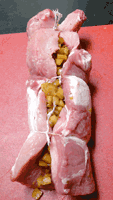
Tie Before Trussing
Have your butcher butterfly the roast or do it yourself by slicing through it lengthwise partway--leaving 1 1/2" intact so you can open it up like a book. Put the roast on plastic wrap and cover with a sheet of plastic wrap. Pound the meat with a meat tenderizer until is is flat. Remove from the wrap and salt and pepper both sides. Run the stuffing in a line down the middle and roll up. Use cooking twine to tie it up in three places, then truss it securely (see video). Put the mirepoix in a deep roasting pan, put the roast on top, arrange sprigs of rosemary around the roast and add the chicken broth. Roast in the oven about 1 hour, until internal meat temperature is 135 degrees, basting with the broth in the pan a few times during the cooking process. Remove roast, tent with foil to keep warm as you make your pan sauce reduction.
Strain the broth and put into a saucepan. Add the wine and cook over high heat until reduced by half. Season to taste with salt and pepper. Remove the twine that trussed the roast, slice into 1 1/2" pieces and drizzle with sauce. Enjoy with a glass of the handcrafted 2008 Jason-Stephens Estate Syrah.


Friday, November 11, 2011

Veterans Day and the Kitchen Table Gang Trust

Baby Boomers like me grew up under the shadow of the Vietnam War. I was a child at the tail end of the 1960s and marched with my parents in peace and civil rights marches. Back then, police were called "pigs" and the military was hated because it drafted brothers, sons, and boyfriends to fight a war that most of us didn't want. I'm still a pacifist and wish our military had not gotten involved in the Middle East, but age and experience has tempered my views of the military. Having met young people who enlisted to make a living in this tough economy, with military enlistment their only hope for a college degree, I have compassion for our troops. Most of them are just kids, just out of high school, and probably naive about what lies ahead in the battlefield. So, when I heard a heartfelt message from Michelle Obama to support our troops, I looked at the Kitchen Table Gang Trust website, run by veterans, which can provide addresses for active military personnel serving in harm's way. I packed beef jerky, ziploc bags and wipes to protect from the dusty wind in Afghanistan, cans of tuna and salmon, nut bars, dried fruit and good Columbian coffee.
A friend of mine, Adam, just returned from half a year in Kabul working as a engineer for a contractor. He was in a restaurant next to the store that was blown up in June, so spent the rest of his time there either in the guarded compound or going out in the field in a heavily armored convoy. Life is precarious in Afghanistan--both for Americans and Afghans. It's difficult to imagine living in fear for one's life, another reason I feel compassion for our young people who find themselves there. You can read about Adam's experience on www.empowertothepeople.org/

Thursday, November 10, 2011

How To Fillet A Fish Like A Pro

Chef Charles Fredericks SBCC School of Culinary Arts
WEEK #12 CULINARY CLASS:
Another excellent class with Chef Fredericks who explained the difference between round and flat fish, covered two cooking competencies: searing and poaching, and how to make court boullion and beurre blanc and how to fillet and break down fish. The first video shows Chef cutting off the top fillet (I wish I'd kept my iphone on longer so you could see the beautiful clean cut he made), the second is the separation of the lower fillet and the third shows the removal of the skin--once again, I cut the camera too soon, so you can't see how perfectly he sliced it off without any flesh left on the skin.
Bright red gills of salmon
In selecting whole fish for optimum freshness, there are 5 points to examine:
  1. The eyes should be clear, not opaque
  2. The gills should be bright red, not dull or dried
  3. The skin should be glossy but not slimy
  4. The scales should be tight, not falling off the fish
  5. The fins should be moist, never dry or cracked
Incidently, the fins of a salmon are one of the two indicators of whether the fish is wild caught or farm-raised: farm-raised salmon will show fusing of the fins together and have thick bones because they are fed calcium to give them extra weight (more weight=more money) and are constricted in their movements, leading to less use of their fins.

When filleting and slicing fish, it's important to have a very sharp knife and make smooth cuts. Dull knives and sawing at fish will damage the cell structure of the flesh and degrade the texture.


Torii Mor Herb-Crusted Rack of Lamb with Red Wine Reduction Sauce:
Ingredients:
1 Tbsp. vegetable oil
11/2 oz. container of demi-glace*
1 large onion, coarsely chopped
1 large carrot, chopped
4 large garlic cloves, smashed
1 Tbsp. Herbes de Provence
1 bottle (750mL) Pinot Noir or other dry red wine
2 14.5-oz. cans low-salt chicken broth
1 tablespoon butter, room temperature
2 teaspoons all purpose flour
½ cup Italian parsley, finely chopped
2 Tbsp. fresh thyme, finely chopped
2 Tbsp. fresh rosemary, finely chopped
2 Tbsp. fresh sage, finely chopped
salt & pepper
5 tablespoons olive oil, divided
3 1½-pound well-trimmed 8-rib racks of lamb, preferably frenched

Heat oil in heavy large pot over medium-high heat. Add onions, carrot, garlic, and Herbes de Provence to pot. Sauté until vegetables are deep brown, about 8 minutes. Add demiglace, wine, and broth to pot. Bring to boil, reduce heat to medium, and simmer uncovered
until reduced by half, about 11/2 hours. Strain into large bowl, pressing on solids in strainer to release all the liquid. Spoon off any fat from surface of stock; return stock to same large pot. Simmer until reduced by ?, about 15 minutes.

Mix butter and flour in small bowl to a smooth paste. Whisk paste into stock. Simmer sauce until slightly thickened and smooth, whisking constantly, about 1 minute longer. Season with salt and pepper. (Can be prepared 1 day ahead. Transfer to small saucepan,
cover, and chill. Rewarm before using.) Combine fresh herbs in a bowl. Add 2 Tbsp. oil and mix until herbs stick together. Season
lamb racks with salt and pepper. Firmly press ? of herb mixture over rounded side of each rack. (Can be prepared 1 day ahead. Place on large rimmed baking sheet. Cover; chill.)

Preheat oven to 350°F. Heat remaining olive oil in large heavy skillet over medium-high heat. Add 1 lamb rack to skillet, herbed side down. Sauté until browned, about 4 minutes. Turn lamb over and sauté until browned, about 3 minutes. Place lamb, herbed side up, on rimmed baking sheet. Repeat, fitting remaining lamb racks on same sheet. Roast lamb until thermometer inserted into center registers 135°F for medium-rare, about 25 minutes. Let lamb rest on sheet 15 minutes. Cut lamb between bones into individual
chops. Arrange 3 chops on each plate. Drizzle with sauce. Serves 8.
Read about our visit to Torii Mor and the Great Oregon Wine Trail.

Wednesday, November 2, 2011

Comfort Food -- The Best Mac 'N Cheese Recipe

WEEK #11 CULINARY CLASS:
This week in class, we made two types of potatoes--hash browns and Potatoes Lyonnaise, roasted tomatoes, and Eggs Benedict. Chef Fredericks explained the technique behind Hollandaise sauce to avoid having the sauce "snap" or curdle.
3 Important Tips For Making Successful Hollandaise:
1. Use clarified butter--as you can see on the chart from last week's post, clarifying butter raises the smoke point 75-120 degrees--so clarified butter has a wider range of stable temperatures during the cooking process.
2. Add water to the egg yolk at the beginning of the process. If your temperature is getting way too hot, adding water will lower the temperature to 212 degrees (water boils at 212 degrees).
2. Keep the temperature of the ingredients between 90 -145 degrees so the yolks don't harden. They will begin to set around 145 degrees. The optimum temperature is about body temperature: 98 degrees. You don't need to use a double boiler if you can keep the heat of the Hollandaise low--if in doubt, use a double boiler!
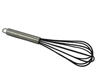
3. Use the proper whisk and proper whisking technique--use a balloon whisk with many wires, designed for sauces.
Hollandaise is an emulsion--the blending of two dissimilar ingredients together. No, the emulsion is not between the egg and lemon juice! The emulsion is between butter and air, with the egg yolk being the emulsifier. The lemon juice is a flavoring component which is added after the basic sauce is made.
HOLLANDAISE SAUCE:
1 lb. butter
2 egg yolks
juice of 1/2 lemon
splash of Tabasco sauce
Clarify the butter by bringing it to a hard boil. At first, the butter will look opaque, but after a couple minutes of hard boil, the surface between the bubbles will begin to be clear. The butter in the photo is just about ready--you still see some streaks of opaque milk solids on the surface. When the surface is clear, pour the butter into a measuring cup and let the milk solids settle to the bottom. You can pour the clarified butter from the top. You should get a 75% yield from your butter--meaning that the water that evaporates out and the milk solids that settle our represent 25% of the original butter.

Fill the bottom of the double boiler with water and heat until it is just below a boil. In the top of the double boiler that is set on the counter, whisk the egg yolks with about 3 Tbsp. warm water. Begin to drizzle in the butter, whisking continuously. As Chef Fredericks mentions in the video, if too much butter is added and the mixture looks greasy, whisk faster until it is incorporated. If the sauce becomes too thick and starts to clump up, drizzle in warm water and whisk thoroughly--adding in small amounts until the sauce is smooth again. It should be a lemony yellow color. Whisk in the lemon juice and Tabasco. Then, cook over the double boiler, whisking continuously, until the sauce is thick enough to coat the back of a spoon, but then flow off the spoon. Serve immediately. The warmth and high protein content of Hollandaise provide an ideal breeding ground for bacteria, so do not let it sit out more than an hour and do not reheat it.

If the Hollandaise breaks, put about 3 Tbsp. warm water into a clean bowl and drizzle a bit of the broken sauce into it, whisking furiously. Continue whisking as you slowly add the broken sauce--it will come together but will never have exactly the same smooth, creamy texture and fluffiness as a well made sauce. Makes 1 1/2 cups of sauce.
Chef Charles Fredericks Making Hollandaise:
Year after year, macaroni and cheese is at the top of the list of foods our kids want for Thanksgiving. This recipe is extra rich and cheesy. I asked for this recipe years ago at Aunt Kizzy's Back Porch in Los Angeles, home of great Southern food.
Aunt Kizzy's Macaroni And Cheese Recipe:
2 lb. dry macaroni, cooked according to package directions
4 Tbsp. butter
4 Tbsp. flour
2 cups of evaporated milk
4 cups + 3/4 cup grated sharp Cheddar cheese
1/8 tsp. black pepper salt to taste Preheat the oven to 350 degrees. Scald the milk (heat in a saucepan--do not let it boil). In a separate saucepan, melt the butter and whisk the flour into it. Cook over low heat, whisking, for a couple of minutes--do not let the mixture brown. Whisk in the warm milk and cook until smooth. Add 4 cups grated Cheddar cheese and pepper; add salt to taste. Mix with the cooked pasta and put into 8" baking dish. Top with extra grated cheese. Cover with foil and bake for 30 minutes, then uncover and bake another 30 minutes or until golden brown on top.
Pair with California Cabernet Sauvignon.

Thursday, October 27, 2011

The Perils and Pleasures Of Pork

WEEK #10 CULINARY ARTS CLASS:
Another great class with Chef Fredericks where we made pork cutlets, homemade applesauce, wilted swiss chard with pancetta and potatoes au grain. Online, I discovered Chef Fredericks was a Dinner Chef at the James Beard Foundation in 2002, a great honor. Chefs are invited to cook a five course meal, plus three to five hors d'oeuvres, for 74 guests at the Foundation. You can take an interactive tour of the James Beard Foundation kitchen here. I dig the wallpaper! Also, take a look at their recipes, the Tawa Baingan (eggplant and potato layers with coconut sauce) looks especially good.

Chef Fredericks paired his James Beard Foundation menu with Brewer-Clifton wines which are from the Santa Rita hills in Santa Barbara County. I haven't had the chance to sample them, but I know that one of the two partners, Steve Clifton, owns the local winery Palmina which makes nice Italian varietals.
What is a sautoir? A deep, wide, straight-sided frying pan used in classic French cooking for braising, pan frying and sautéing. It is particularly useful in the kitchen because it can go from stove top to oven. Buy one with a thick bottom, long handle and tight fitting lid. Like your Dutch oven, you will end up loving this kitchen tool!

NOTES ON COOKING OIL:
Use a high-smoke point oil (best over 420ºF) for deep frying and pan frying. At Culinary school, we use olive oil pomace which is made from the pulp of the olive oil after the first press for extra virgin olive oil. It has less flavor, but a higher smoke point.
Here's a table of common cooking fats and their smoke points:

Butter260ºF
Refined safflower oil320ºF
Clarified butter (or ghee)335-380ºF
Pork lard370ºF
Walnut oil350-400ºF
Extra virgin olive oil350-410ºF
Margarine410-430ºF
Vegetable oil410ºF
Pomace oil410-440ºF
Canola oil*430-445ºF
Refined sunflower oil460ºF
Corn oil450ºF
Cottonseed oil450ºF
Peanut oil450ºF
Refined soybean oil450ºF
Soybean oil495ºF
*Personally, I avoid canola oil in all my cooking. Have you ever heard of a canola plant? No--because there is no such thing. Canola is made from hybridized rapeseed plants which normally contain erucic acid. Most canola oil is processed using a petroleum product called hexane.

One of the many things I've learned from Chef Fredericks is the importance of contrasting flavors. We made applesauce with apple cider vinegar--just enough to give a bright zing to complement the sweetness of the apples and brown sugar. It's those little nuances that make the difference between a good cook and a real chef.
EASY HOMEMADE CHUNKY APPLESAUCE:
4 large tart apples, like Pippin or Granny Smith
1/4 cup apple cider vinegar
1 1/2 cup water, approximate
1 cup brown sugar, loosely packed
pinch cinnamon
Peel the apples, remove the core and chop into a small dice--about 1/4" cubes. Place in a saucepan with the vinegar and enough water to fill the pot just below the level of the top of the apples. Cook for 45 minutes to 1 hour on the stove over low heat, stirring occasionally, until the apple is soft but not mushy. The water should cook away, leaving a thick sauce--add more water during the cooking if needed, or increase the heat to evaporate some of the water if the sauce is too watery. Add the sugar and cinnamon to taste. Stir the sauce just until some of the apple is broken up but chunks still remain. Serve with the pork cutlets above.

Why did I title this post "The Perils and Pleasures Of Pork"?  I taste what we create in Culinary class to learn how to be a better cook, but my avowed vegetarianism is threatened by pork products. I took one nibble of the pork cutlet and ended up eating both of them. The crispy pancetta in the wilted swiss chard was irresistable. I fell off the vegetarian wagon yesterday, but I'm back on today, making buckwheat blueberry pancakes for breakfast and loading up at Lane Farms with organic veggies.

This recipe is from my childhood:
Crispy Panko-Crusted Pork Cutlet:
2 pork cutlets
1 1/2 cup flour
1 egg
1 cup Panko bread crumbs
2 cups, approximate, oil for frying*
salt and pepper
In a sautoir or deep frying pan, pour in oil to a depth of 2" and heat over medium heat. The oil should be hot, but not smoke. To set up your standard breading procedure, you will need 3 wide, shallow bowls. The flour goes in the first, the egg in a second (whisk the yolk and whites together thoroughly with a fork), and the Panko in the third bowl. Season the cutlets with salt and pepper on both sides, dredge in the flour, then dip in the egg, then in the Panko. Using long tongs, carefully put the cutlets in the oil. They will sink to the bottom. The oil should be bubbling around the cutlets. After a few minutes, the cutlets will rise to the surface. Turn with the tongs and continue cooking until golden brown. Drain on two layers of paper towel, then slice and serve.