My photo
Santa Barbara, CA, United States
I enjoy creating original wine-pairing recipes that are healthful and delicious. I work for Touring & Tasting a Santa Barbara based wine club and national magazine as Food Editor. However, I am not paid for this blog and the opinions expressed here are strictly my own. I received my Personal Chef Skills Competency Award from the SBCC's School Of Culinary Arts. In 2012, I started Inside Wine - Santa Barbara with pal Lila Brown which features wine tastings with winery owners and winemakers. I also serve on the Board of the Santa Barbara Culinary Arts group, which had Julia Child as one of the founding members and funds scholarships for SBCC culinary students in her name.

Search This Blog

Monday, April 23, 2012

Hot and Tasty

As the Culinary Institute of America's wine book Exploring Wine states, "The dedicated farmers and producers of Santa Barbara County set a high benchmark for California wines". Indeed they do! The comedy "Sideways" may have helped bring recognition to the area, but it has been the quality of the wines that have piqued the interest of the wine writers, like Robert Parker, Jr. who said, "No viticultural region in America has demonstrated as much progress in quality and potential for greatness as the Central Coast, with its Rhône varietals, and the Santa Barbara region, where the Burgundian varietals Chardonnay and Pinot Noir are planted in its cooler climates." He predicts our wine "will rule America". Wow. But, our wineries weren't polishing up their "I am king of the world" speeches over the weekend, they were pouring wine at the Santa Barbara County Vintner's Association Festival--the highlight of their four-day spring celebration of Santa Barbara wines.


Unfortunately, the capricious weather gave us a mini-heat wave and the gorgeous blue sky drove the sunlight unrelentingly on our heads. So, I ended up drinking water rather than wine as my baked tongue couldn't evaluate the wines and everything tasted "cooked" to my overheated palate. The exception was Palmina's Barbera. I have my own theory (unsubstantiated other than personal observation) that while other reds start to turn the day after being opened, Barbera stays fresh and sometimes even gets better after three days in an open bottle. Once again, the sturdy Italian varietal showed its mettle by holding up and tasting delicious, even in oven-like conditions. Summation: the next time I'm invited to a BYOB in the desert--I'll bring a Barbera.

I spent the afternoon stuffing myself with all the tasty tidbits being given out by local restaurants, like the calamari salad from Root 246 and luscious meatballs from Trattoria Grappolo and people-watching, which is always a fun activity at any wine tasting. There are some who come to sip wines, some who come to guzzle, some dressed to the nines and looking for singles, some just to have a nice day outdoors with friends, then this group looking like lions in a National Geographic photo, draped on the oak tree seeking shade.

Friday, April 13, 2012

Santa Barbara -- Reaching For Stars

Once again, Chef Vincent Vanhecke did an amazing job putting together the fabulous 5-course dinner for the "Reaching For Stars" benefit for the Youth and Family Services YMCA. The Youth and Family Services runs four programs: Outreach to homeless youths--providing a sleeping bag and rain-wear, food for the hungry, a professional who cares, and a bus ticket home; the Isla Vista Teen Center--a drop-in center away from gangs, alcohol and drugs; My Home at Artisan Court--transitional housing and counseling services to youth ages 18-21 who age out of foster care and are facing homelessness; and Noah's Anchorage--a shelter for foster children, runaway and homeless youth ages 10-17.

Once again, (read the post) we were seated at the table with the keynote speaker, a lovely and friendly young girl who plans on attending Cal State Northridge and going into public relations. She was scribbling notes for her speech during the meal and started off speaking bravely about the challenges of growing up without a family to support and encourage her, how it felt to be the only one at school without a stable home, and how she asked only for a miniature Christmas tree when she moved into the Family Services housing at the holidays because it was something she hadn't had...and then she broke down. Many of us in the audience were in tears also. It's heart-rending to hear the stories of the kids that have had foster families that were only in it for the money, of abusive homes they had to escape, of living without a roof over their heads. It's a wonderful thing that the YMCA and the Santa Barbara Housing Authority plus generous donors have created services to help these kids that otherwise would truly be alone.

Also commendable are the chefs, particularly Chef Vanhecke, who donated their expertise to help raise money for these services. This year, there were even more top chefs, compared with two years ago (read about the 2010 Reaching For Stars dinner) and the students from the School of Culinary Arts at SBCC had a bigger role to play. I talked a bit with Chef Vanhecke after the dinner and he said that the students helped prepare some of the components and created the luscious appetizers that were served at the beginning of the evening when we had the chance to play some casino style games. I mistakenly left my iphone at home, so had to borrow a phone. These poor quality photos don't do justice to the food.

Appetizers: Vincent Vanhecke (The Valley Club of Montecito),  Randy Bublitz, Stephane Rapp and students (School of Culinary Arts SBCC)
Gary and Paul (right) Arganbright, President Touring & Tasting
First Course: Alessandro Cartumini (Four Seasons Biltmore), Charlie Rushton (Four Seasons Biltmore), Michael Blackwell (Montecito Country Club)
House Cured Duck Prosciutto with a Citrus Watercress Salad
Royal Trumpet Mushroom Salad with Celery, San Joaquin Gold, Walnut Vinaigrette
Cold Smoked Duck Breast
Won Ton Cup, Goat Cheese Cream, Roasted Yellow Beets, Micro Greens, Basil Oil,
Fleur De Sel, Kalamata Olives

Second Course: Micheal Hutchings (Micheals Catering),  James Sly (Sly's), Mossin Sugish (Blush)
Cultured Cocktail Abalone Baked with a Gremolata Butter
Salmon "Soufflé" Auberge de l'île
Cauliflower Horseradish Chaud-Froid, topped with a Paddle Fish Caviar
Entrée: Greg Murphy (bouchon), Brandon Hughes (Wine Cask), Charlie Fredericks and students (The Restaurant at SBCC)
Wagyu New York
Braised Short Ribs
Crispy Sweetbreads
Cheese Course: Don Skipworth. (Private Chef), Mari Bartoli (Private Chef), Brian Parks (Private Chef)
Salade Tropical
Chèvre Medallions with Orange and Cherimoya,
Hollandia Butter Lettuce and Lilikoi Citrus Dressing with Pistachio Garnis
Dessert Course: Christine Dahl (Christine Dahl Pastries),  Eric Widmer (La Cumbre Country Club), Jamie West (Private Chef)
 Warm Raspberry Phyllo Cheesecake Triangle
Chilled Raspberry Soufflé
Raspberry Tea Infused Chocolate Mousse Crunch Cake
Wines Donated by: Gainey, Cottonwood Canyon, Deep Sea, Fess Parker Winery, Jordano's, Lucas & Lewellen, Melville, Oreana, Roblar and Zaca Mesa.

Tuesday, April 10, 2012

When Bigger Is Better

Some people, including many connoisseurs more expert than I, hold the opinion that French wine is the most superior in the world --witness the astronomical $1,000 plus price per bottle for Grand Cru Bordeaux. But, while I appreciate the finesse and complexity of French Bordeaux and Rhone blends, I learned to love wine by drinking our California reds such as Napa Cabs, Russian River Pinots, Paso Robles Rhone Rangers, Santa Barbara Pinots and Syrahs.
IMHO, Old World French wine tends to be softer and earthier, whereas New World wines encompass a wider range of flavor and structure profiles and tend to be bolder. They can be "hot"--over 14% alcohol--and fruit-forward, with firm tannins--wines that make a confident statement, without going over the top. I will declare, (I assume the persona of Mae West when I say this): I like my red wine like I like my men--big, bold and hot!
Three Wines The other evening, I made pasta all'uovo from scratch and a fully flavored marinara sauce with handfuls of fresh herbs from my garden and half a head of garlic. We needed a hearty red wine to pair with this meal, so we sampled three wines from the Touring & Tasting cellar: the 2008 Eberle Cote-du-Robles from Paso Robles, the 2007 Pietra Santa Zinfandel from the Cienega Valley 25 miles east of Monterey Bay, and the Argentinian 2010 Tinto Negro Malbec.
The Eberle Cote-du-Robles is the equivalent of the cultured, educated man who will wow you with his depth and intensity. He has tales to tell and universes to open to you. Be mesmerized as you enjoy a long, leisurely dinner of foods slow cooked with many flavors, like meat braised in wine or vegetable tagine spiced with curry. Slowly savor each delicious sip.
Malbec can be so tannic that it's like a mouthful of vine; but not the Tinto Negro Malbec--it is rich with fruit. The tasting notes for this wine says: "Surprising light for a Malbec, this wine is approachable and delicious". But, make no mistake, this is not a light wine. It is a muscular, proud Argentinian with flashing eyes that dare you to live life to the fullest. This Malbec will grip you with strong arms and whirl you around the dance floor with fearless tenderness. Serve with grilled steak--preferably on the wild, grassy hills of the Argentinian Pampas.
Zinfandel was long considered "America's vine and wine", a true American product. Zinfandel has concentrated flavors because the grapes ripen unevenly and are often berry selected for this reason. The "old vine" Zins have very low yields, leading to more extraction.  Because the fruit ripens fairly early and produces juice with high sugar levels, the alcohol content is often over 14%, sometimes over 15%. I love it because the deep fruit flavors of berries and plum are complemented with spicy and peppery notes. Zinfandel is like my California man, big, tall and self-assured. I see him golden from the sun, like a luscious grape ripened to perfection. He's not afraid to get his hands dirty with hard work, but the same strong hands have the gentleness to harvest a cornucopia of pleasures from the fertile soil. The Pietra Santa Zinfandel , handcrafted from estate grapes cultivated to express the land, was the perfect pairing for a meal made from a Southern California kitchen garden.

Monday, April 2, 2012

Tempting Tempranillo--A Blind Tasting

Paul, Touring & Tasting president (left), and Dorothy Schuler

Paul Arganbright, Touring & Tasting president, and I attended the Santa Barbara chapter of the American Wine Society (AWS) last week. The AWS includes wine lovers from novice to expert, amateur and professional winemakers, and people in all aspects of the wine trade. This meeting was a blind tasting of five Tempranillos--two from Spain, one from Argentina, and two from the USA--and featured Dorothy Schuler, president of the Tempranillo Advocates Produces and Amigos Society (TAPAS) and winemaker at Bodegas Paso Robles.

Tempranillo grapes have a thick skin which contribute tannins and color, but little acidity--something that can be rectified when they are grown in areas where the nighttime temperatures plunge, like Paso Robles. Tempranillo doesn't oxidize quickly, so it ages well. It's a refined wine, especially compared to other ones made from hot climate  grapes, and goes well with one of the main ingredients in Spanish food: olive oil.

Embarrassingly, I did not guess one wine's origin correctly. Fittingly, as he selects all the wines for our wine clubs, Paul not only correctly identified each wine's origin, but also determined that the two American wines were from Paso Robles and probably from Bodegas Paso Robles--which they were. A win for Paul!

We nibbled on crisp cucumber topped with beets (my favorite!), Manchego cheese in olive oil, endive stuffed with herbed grain, cucumber shots, and other treats. I believe this was the fifth meeting of the newly formed Santa Barbara chapter. Join here

Tuesday, March 27, 2012

Wesley and Donna Anderegg--ceramic artists and winemakers

by Wesley Anderegg
Cindy with a work of culinary art
Here's a great food/wine pairing: a young, light bodied Pinot Noir served with three-cheese quesadillas, corn salsa and spicy red pepper sauce--here shown by artist and friend Cindy Hoffman. We had this lunch in the adobe house of Wesley and Donna Anderegg: ceramic artists who also happen to be gourmet cooks and home winemakers. They produce around two barrels of Pinot on their farm which is in the windswept rolling hills of the Sta. Rita AVA, wine that is not for sale, but for personal consumption. The lunch was just one of the delights of a ceramic workshop in their huge, light-filled studio. Wesley's work is in numerous museums around the country; he makes sometimes whimsical, sometimes macabre but always visually arresting sculptures and paintings. Donna throws, paints and carves beautiful dinnerware.

Wesley and his charmingly helpful daughter Izzy showed us how he hollows out the basic head and body forms, then adds the features and appendages. He uses his own blend of clay that is low fire, but smooth, without the rough grog often found in earthenware clays. He blends it to be very moist; the clay is supple and smooth to the touch--easy to mold but requiring some delicacy in the handling. He formed this hand in just a couple of minutes, deftly adding the details like knuckle wrinkles and finger nails--he made it look so easy!

Before the workshop, he had made a delicious apple galette and we had the lunch described above, with the Anderegg Pinot Noir. We had the chance to pet their goats, marvel at the rambling adobe house and breathe the fresh spring air blowing across the verdant hills.

The Sta. Rita AVA is unique in the transverse (meaning east-to-west, rather than north-south) mountain ranges that funnel ocean air into the sunny interior of Santa Barbara County. Locals call it the "maritime throat" as it blows cooling fog, combining with the rocky soil to make perfect conditions for growing Pinot Noir, as evidenced by the high scores and acclaim won by many wineries such as Sanford, Longoria and Sea Smoke.

One of the pioneers in viticulture was Richard Sanford who planted the first Pinot Noir vineyard in the area in 1970. Armed with a degree in Geography, he researched land and climate across the state and discovered the Santa Rita Hills had similar terroir as Burgundy, France. He and his wife founded the eponymous winery and produced award-winning wines for 27 years before leaving Sanford to their partners and creating Alma Rosa winery in the same AVA. The Sanfords were instrumental in establishing the tiny (about 100 acre) AVA. Current majority partners in Sanford Winery, Anthony Terlato and his sons Bill and John, continue the legacy of producing highly-rated wines: Chardonnay and Sauvignon Blanc, in addition to Pinot Noir. Sanford Winery is on the picturesque Santa Rita Hills wine trail. Stop in and taste wines in their showcase tasting room and winery, built mostly from recycled materials, including 15,000 handmade adobe bricks.

Wesley Demo
You may wonder why the proper name for the AVA is "Sta. Rita" instead of "Santa Rita" when the location is the Santa Rita Hills. This came about because a Chilean wine producer, Viña Santa Rita, which has been making wine in that country for 130 years, filed a lawsuit against the U.S. Department of Treasury (which overses the Bureau of Tobacco, Alcohol, Firearms and Explosives, and threatened to sue any winery that used the Santa Rita name. Richard Sanford met with the Chilean producer and was able to work out a compromise. The abbreviation "Sta." is historically accurate, since it was used for Mexican land grants in California's early years.

Sunday, March 18, 2012

A Mediterranean lunch on a rainy afternoon

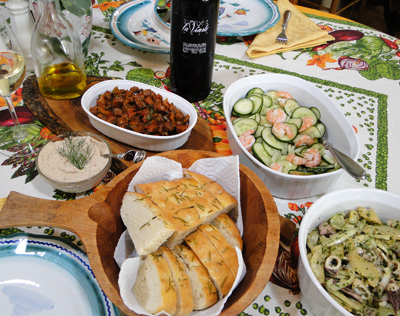
My "baking buddy" Lila from the Culinary School came over yesterday to bake ciabatta, focaccia and small plates to go with the breads. Lila had a catering company in the Bay Area before moving to Santa Barbara and has attended culinary school in Turkey and Italy--and maybe other schools in her amazing world travels. She brought the cookbook Purple Citrus & Sweet Perfume by Silvena Rowe to make an artichoke/squid salad and sweet-and-sour eggplant caponata--now two of my favorite recipes. I made the cucumber/shrimp salad with the addition of fresh fennel bulb and leaves, and tuna mousse (recipe). We washed it down happily with the perfect pairing of a ribolla gialla wine from the Friuli region that Lila brought: the La Viarte, which was light and nicely acidic.

Lila showed me how to clean squid:
1. Cut off the tentacles and set aside.
2. Use the back of your chef's knife to scrape the skin from the outside--moving from the tail towards the head. At the same time, the insides will be squeezed out.
3. Pull out the transparent bone. You should be left with a hollow tube of white squid meat.


Tama's Shrimp and Cucumber Salad:

1 Japanese or English cucumber with thin, edible skin, about 2 cups sliced
salt
1/4 cup sesame oil
1 tablespoon rice vinegar
1 tablespoon white vinegar
1 teaspoon Mirin (Japanese cooking sake) or 1 teaspoon sugar
*optional 1/2 fennel bulb, sliced thinly
*optional sprinkle of fennel leaves
8 oz. cooked shrimp, cut into small pieces or 8 oz. bay shrimp
Slice the cucumber very thinly and place into a colander, sprinkling each layer with salt. Put the colander inside a larger bowl, cover and put into the refrigerator for half an hour. The salt will draw some of the moisture from the cucumber, making it crunchier. Whisk together the sesame oil, vinegar, soy, and sugar in a bowl. Adjust seasonings to taste--it should be slightly salty and vinegary but not unpleasantly so. Stir into the drained cucumber and shrimp.

Wednesday, March 7, 2012

Birthday Cake With Marzipan Strawberries

I made my first marzipan today--a cup of almond paste mixed with 1/4 cup corn syrup with the paddle attachment of my mixer, then with a cup of powdered sugar added in. I used colored gel instead of liquid food coloring which helped keep the marzipan the right consistency. It could have been a bit drier--next time I would cut the corn syrup a bit. I used the Joy Of Cooking recipe for boiled frosting--it's super thick and difficult to spread. I ended up wetting my hands and using my palms to smooth the frosting on.

I'm trying some cake decorating in preparation for entering the Edible Book Contest this year. Last year's contest was fun, but I think I'll try a cake this year...